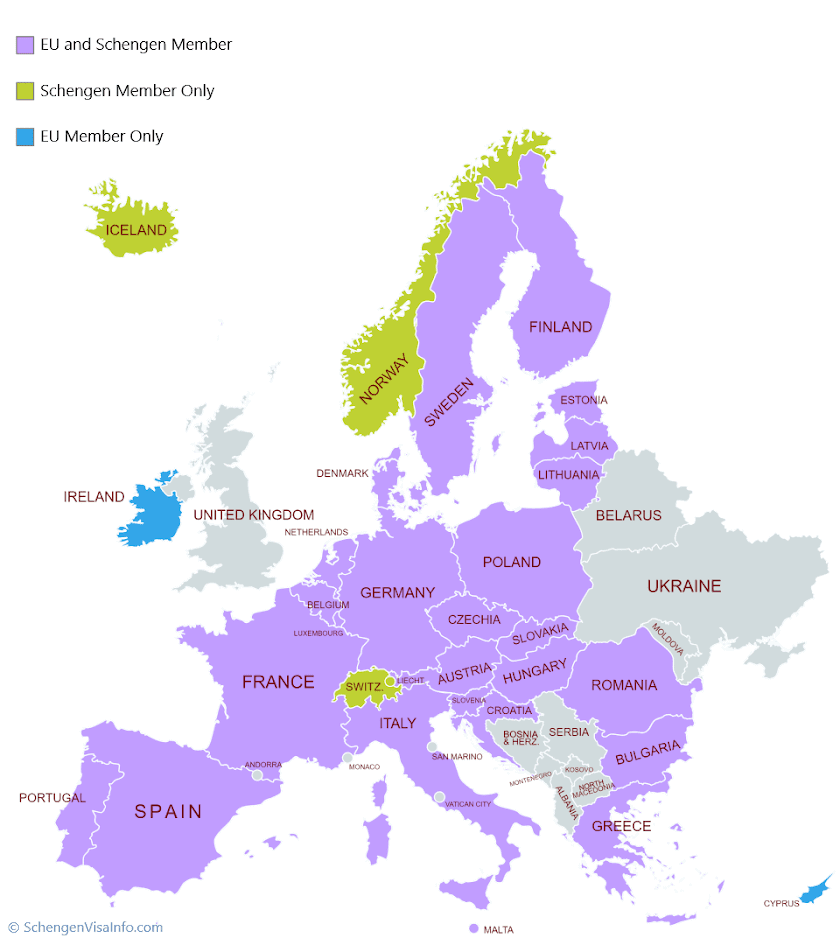
The Schengen Area is a region of 29 European countries that have abolished their internal borders to allow the free and unrestricted movement of people. It covers a vast area of 4,718,084 km2 and is home to over 448 million citizens.
Most EU countries are within the Schengen Area except Ireland and Cyprus which will soon be part of it. Additionally, several non-EU countries like Norway, Iceland, Switzerland, and Lichtenstein are integral members despite their non-EU status
Get your for Schengen Visa
The 29 Schengen countries are Austria, Bulgaria, Belgium, Czech Republic, Croatia, Denmark, Estonia, Finland, France, Germany, Greece, Hungary, Iceland, Italy, Latvia, Liechtenstein, Lithuania, Luxembourg, Malta, Netherlands, Norway, Poland, Portugal, Romania, Slovakia, Slovenia, Spain, Sweden, and Switzerland.
How Does the Schengen Zone Affect My Travel?
A part of the Schengen zone and its members is a uniform visa, otherwise known as a Schengen visa, which most visitors need to visit any country in this area.
So, if you are planning to visit a European country on this list, you need to verify first whether you need a Schengen visa. If you do, you must go through the application process and receive a visa, and only then you travel to any of the Schengen countries.
Iceland, Norway, Switzerland, and Lichtenstein are associate members of the Schengen Area but are not members of the EU. They are part of the EFTA and implement the Schengen acquis through specific agreements related to the Schengen agreement.
Andorra, Monaco, San Marino, and Vatican City have opened their borders but are not members of the visa-free zone.
The Azores, Madeira, and the Canary Islands are special members of the EU and part of the Schengen Zone, even though they are located outside the European continent.
European Countries That Are Not Part of the Schengen Area or the European Union
Here is a list of European countries that are neither members of the European Union nor participants in the Schengen Zone:
Albania
Azerbaijan
Belarus
Bosnia and Herzegovina
Kosovo
Moldova
Montenegro
North Macedonia
Russia
Serbia
Türkiye
Ukraine
United Kingdom
How Does a Country Join the Schengen Zone?
To join the Schengen Area, a European country must go through an evaluation process and be able to meet a specific set of conditions known as the Copenhagen Criteria.
To be able, on behalf of other member countries, to control the external borders of the Area as well as to issue Uniform Schengen Visas
To possess the competence that, after the abolishment of border controls between member states, to capably collaborate with other member countries’ law enforcement agencies for a greater level of security.
To be equipped in applying “Schengen Acquis” or rules for controlling land, sea, and air borders, issuing short-stay visas, police collaboration as well as protection of personal data.
To be ready to join and put in use the Schengen Information System (SIS).
While Schengen strives for unrestricted movement, occasional security checks by the police might occur, although these checks are not intended to be as extensive as full border controls.
The UK is not a Schengen country because it has opted to maintain its own immigration and border control policies. Therefore, if you are travelling to the UK, you will be subject to the UK’s specific visa and entry requirements, which are separate from the Schengen Area.
No, out of 45 European countries, only 29 are in the Schengen Area. Some have opted out of the agreement, and others do not currently meet the eligibility criteria to sign it.
No, it is not possible to travel to Ireland with a Schengen visa. Despite being a member of the European Union, Ireland has chosen to stay outside the Schengen Agreement, maintaining its independent visa and border control systems.